
A personal journey through glass at Homo Faber 2026 on the island of San Giorgio Maggiore, Venice.
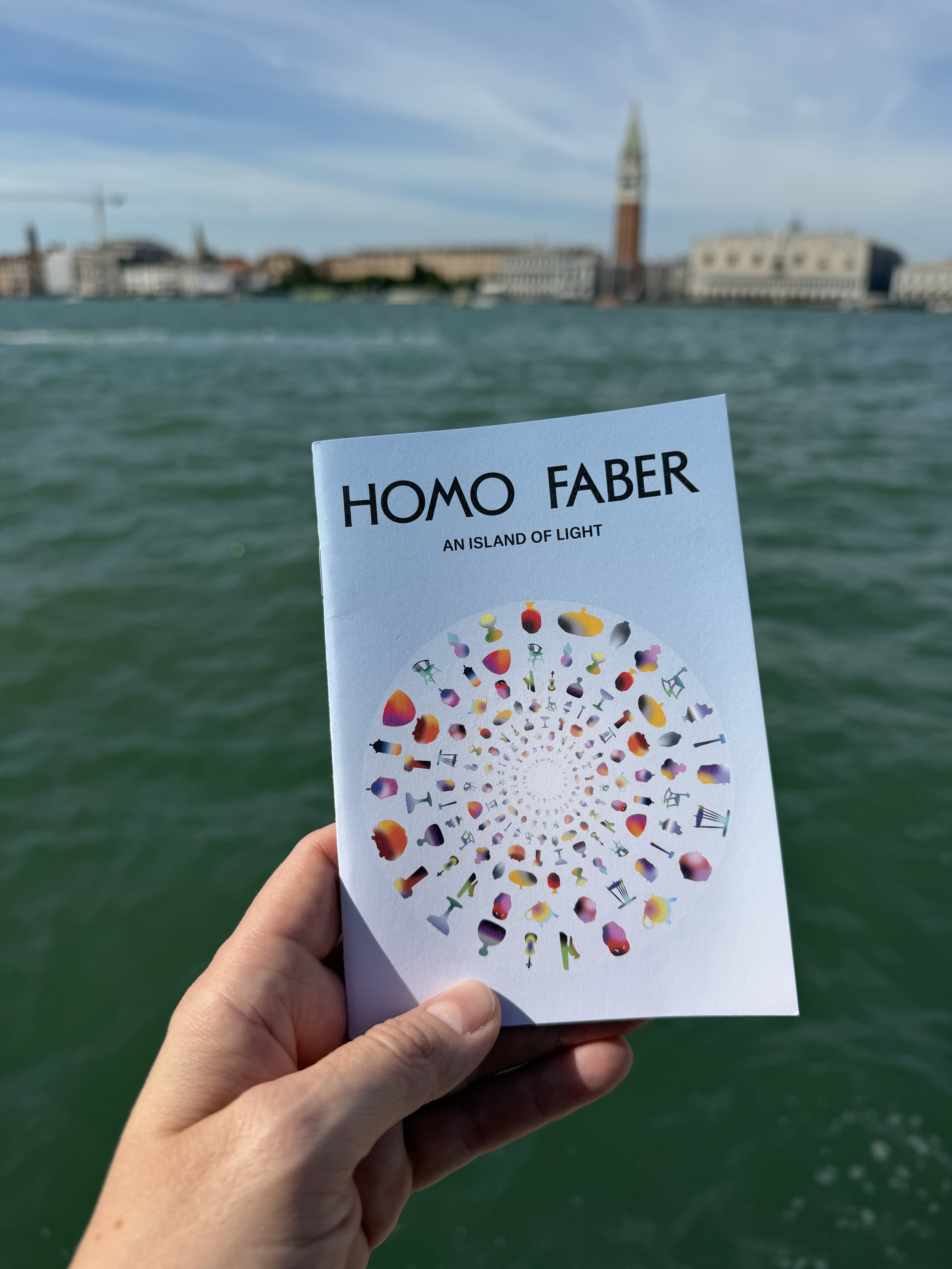
Homo Faber 2026 exhibition guide against a view of Venice from San Giorgio Maggiore.
Homo Faber 2026 closed yesterday, 30 September. Looking back on my visit to An Island of Light at Fondazione Giorgio Cini, I keep returning to the moments when glass seemed to change character before my eyes. Across the exhibition it could appear weightless or geological, intimate or theatrical. It could hold colour deep inside a form, or release it into the space around it.
This is a personal route through the works that stayed with me. The exhibition brought many materials together; I followed glass from room to room, paying attention to the first impression each object made and to what emerged when I stayed a little longer.
An Alphabet of Objects
The route began with An Alphabet of Objects, where a moving display brought objects and their shadows into conversation. In a room devoted to the language of silhouettes, glass had a particularly elusive presence: solid enough to be an object, yet always allowing light to complicate its outline.
Quercia and Salice by Michela Cattai and Andrea Salvagno held my attention through the relationship between their central stems and the glass forms unfolding around them. The upright cores give the pieces a firm structure, while the leaf-like elements have irregular, gently creased surfaces. Some face outward; others turn almost edge-on, appearing as dark, narrow lines. I found that contrast particularly compelling: within each sculpture, the glass feels substantial in one place and almost weightless in another. Their shadows on the wall gather these delicate differences into bold, compact silhouettes.
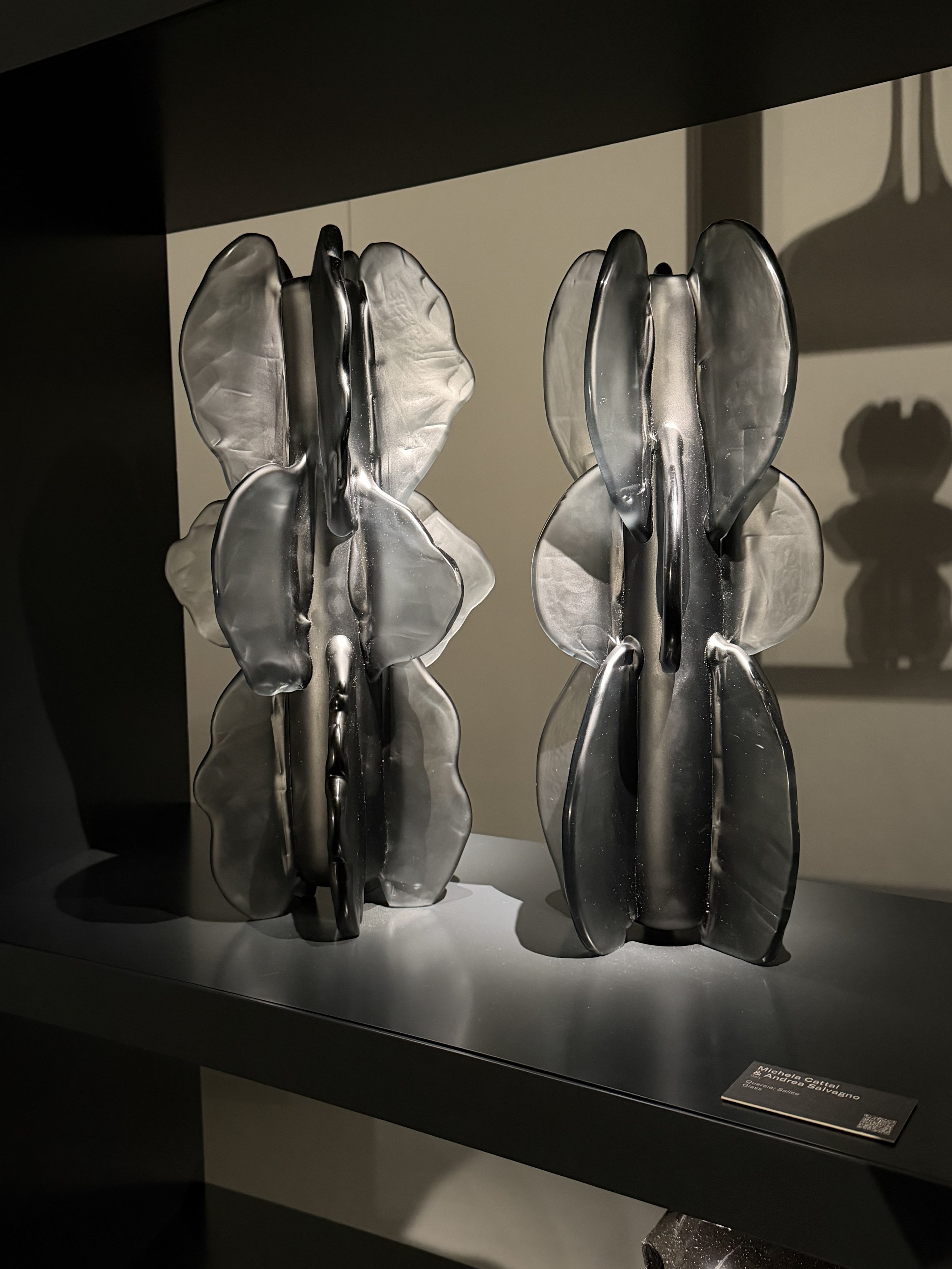
Michela Cattai and Andrea Salvagno, Quercia and Salice. Installation view, An Alphabet of Objects, Homo Faber 2026.
Cathryn Shilling’s Metamorphosis IV initially looks like a fold of fabric suspended in mid-air. Its surface is made of fine, repeated glass lines, so the closer I look, the more the apparent softness becomes a feat of structure. The sculpture suggests a body in motion without describing one. It holds that moment between drape and tension, when something flexible appears ready to shift again.
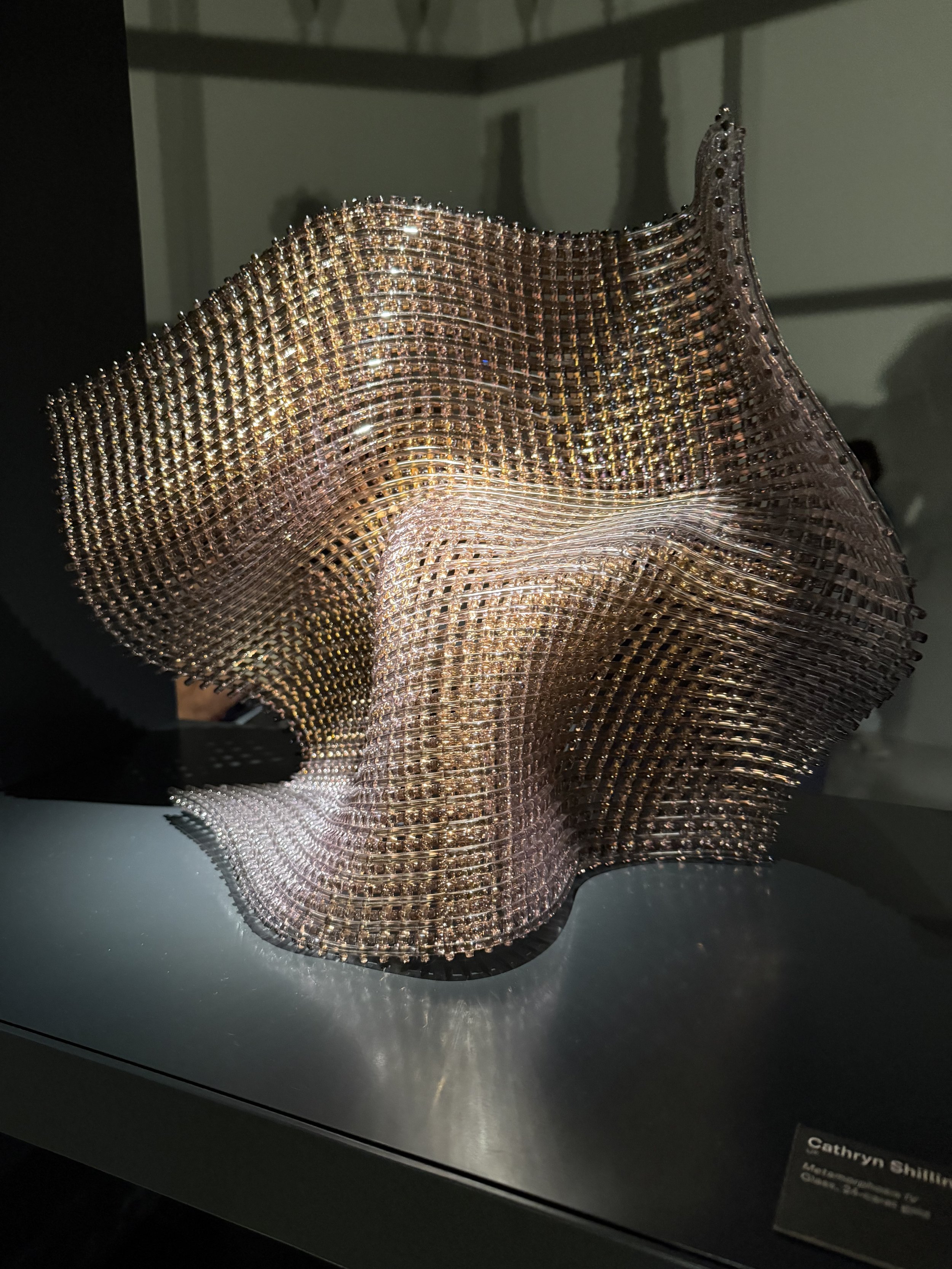
Cathryn Shilling, Metamorphosis IV. An Alphabet of Objects, Homo Faber 2026.
My eye followed Hidenori Tsumori’s Remnants Of ’26-4 upward, from the small clustered forms to the tall, narrow vessels at the far end. Each tapers towards a pointed base, while its open rim is uneven and finely jagged. That combination gives the group an unusual tension: the forms rise confidently, but their edges look vulnerable. What surprised me most on closer inspection was the granular surface. The pale rims seem almost crusted with tiny particles, gradually darkening down each vessel. Together, they create a rising rhythm that remains full of individual irregularities.
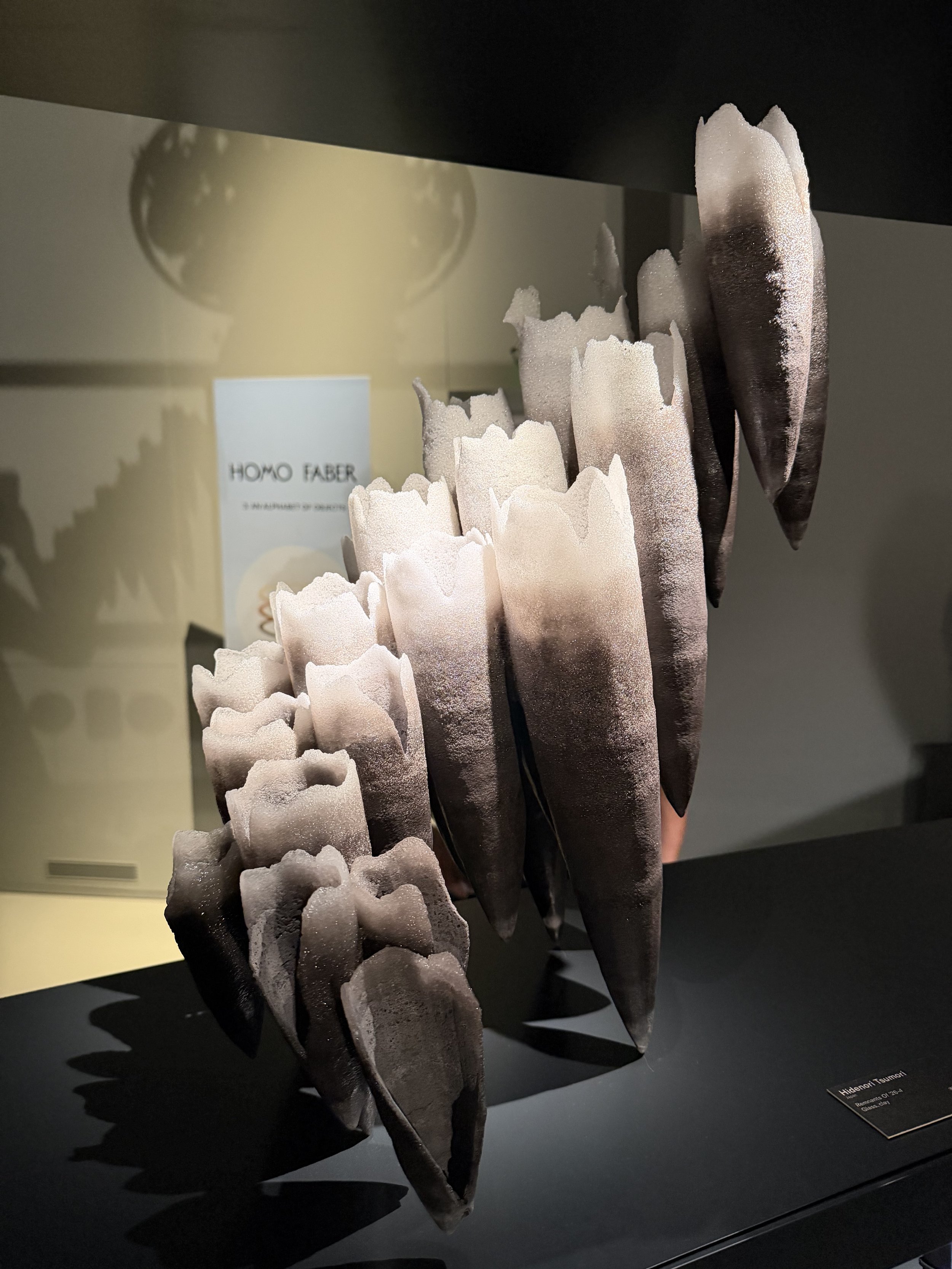
Hidenori Tsumori, Remnants Of ’26-4. An Alphabet of Objects, Homo Faber 2026.
A Full Moon Rising
The next change of scale came at the former swimming pool. A Full Moon Rising placed vessels around and above the reflective water, with the circular display appearing to lift out of its own reflection. It was one of those spaces that made me pause before choosing an individual work to look at.
The long perspective of the pool draws the eye towards the illuminated circle. Its mirrored image completes the form below, making the display seem at once architectural and fleeting. The vessels are small within this view, but the setting gives each one a relationship with water, light and the idea of holding something.
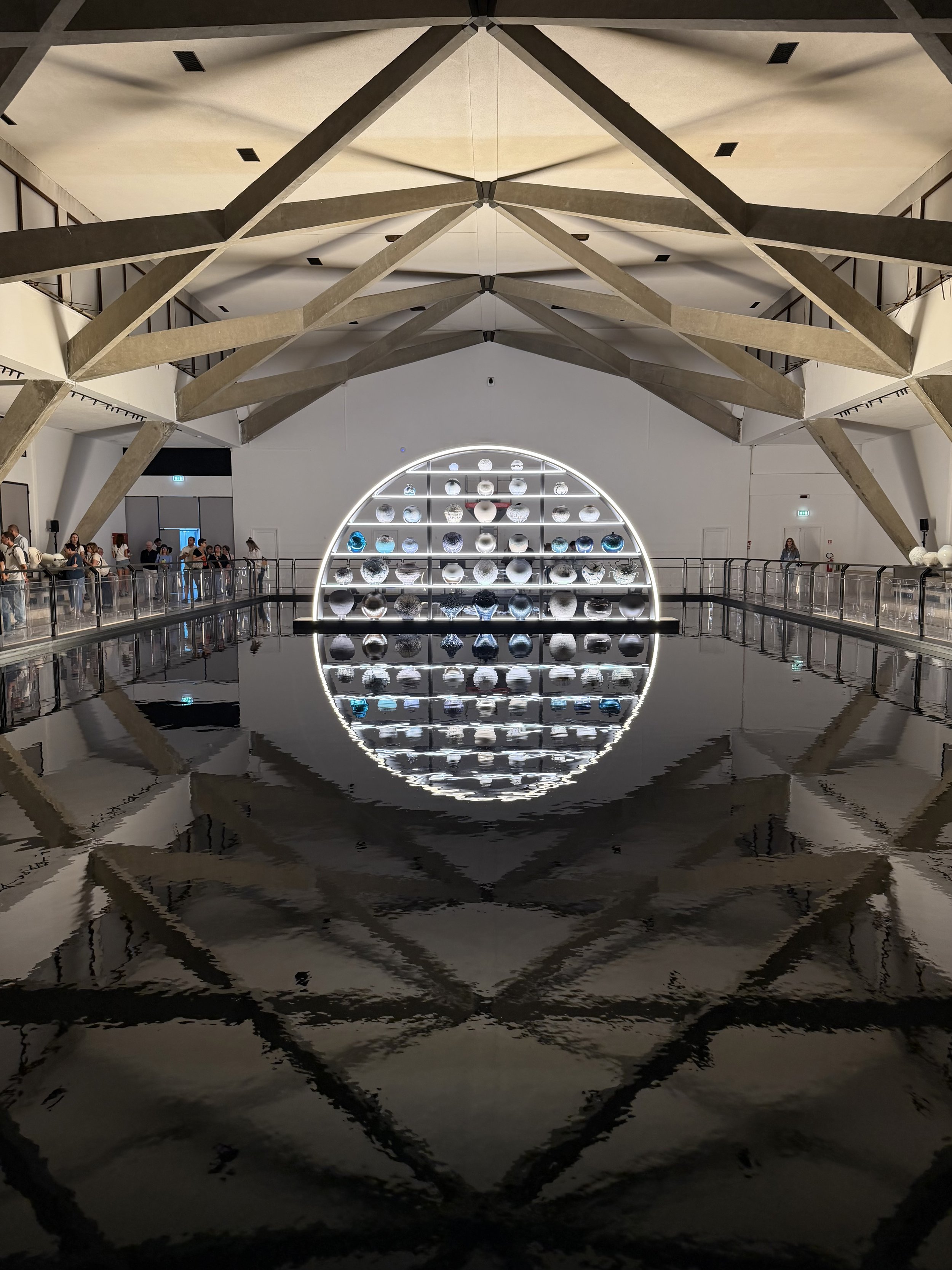
Installation view, A Full Moon Rising, in the former swimming pool at Fondazione Giorgio Cini, Homo Faber 2026.
Jeff Zimmerman’s Untitled (Crumpled Vessel) seemed to have been caught in the middle of becoming. The cool, metallic blue surface folds in on itself, then opens into bright, fluid reflections. I noticed the apparent softness first; only afterwards did the weight and precision of the glass register. It made the familiar outline of a vessel feel provisional, as if its final shape had been decided in an instant of heat.
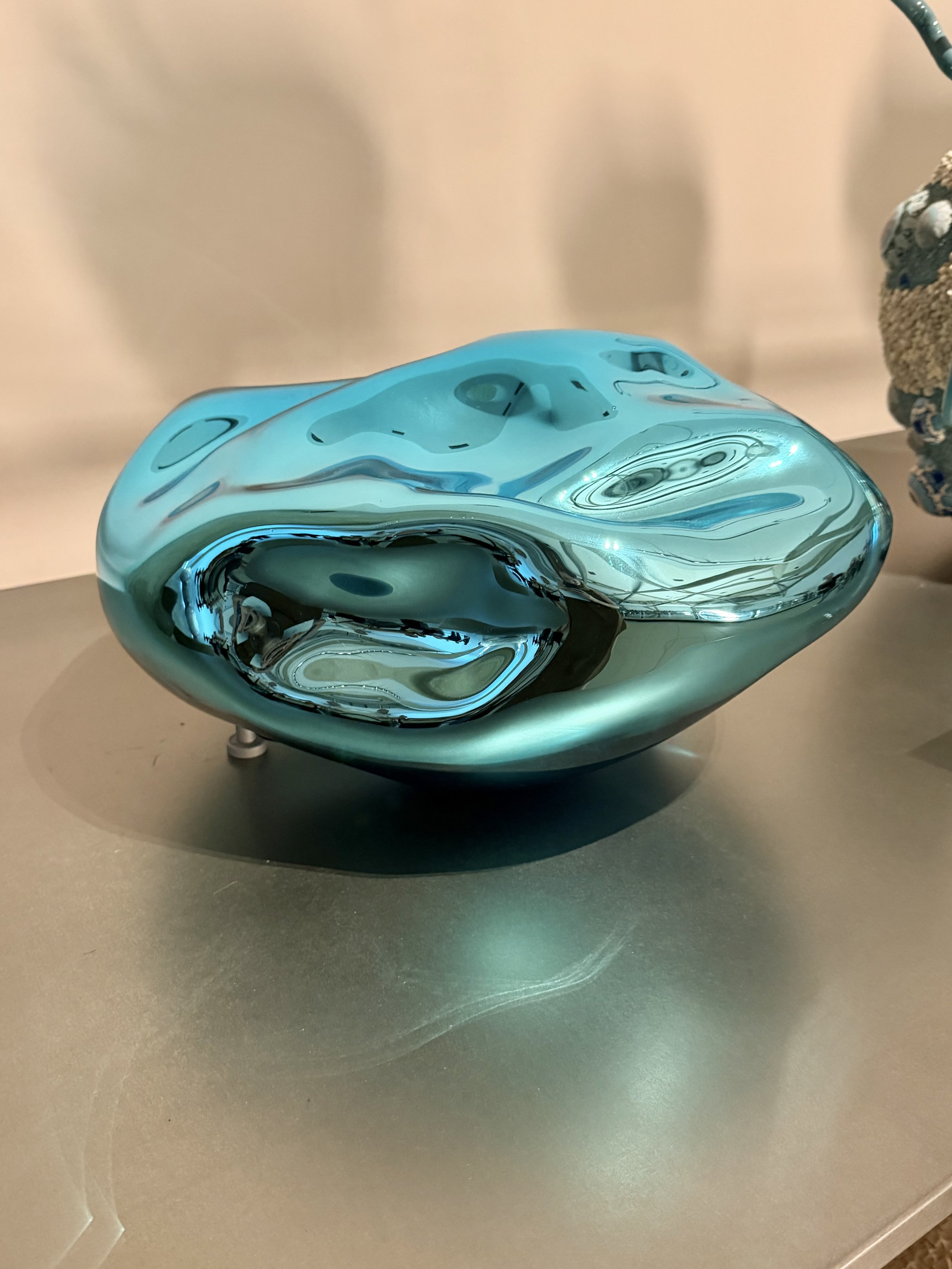
Jeff Zimmerman, Untitled (Crumpled Vessel). A Full Moon Rising, Homo Faber 2026.
From across the courtyard, Rivivo looked like one exuberant red form. As I came closer, I began to recognise the rims and curved sides of vessels among its many pieces. That was what surprised me most: each fragment still seemed to have a shape of its own, yet from a few steps away they came together as a single sculpture. I kept looking from the whole back to the details, finding another recognisable curve each time.
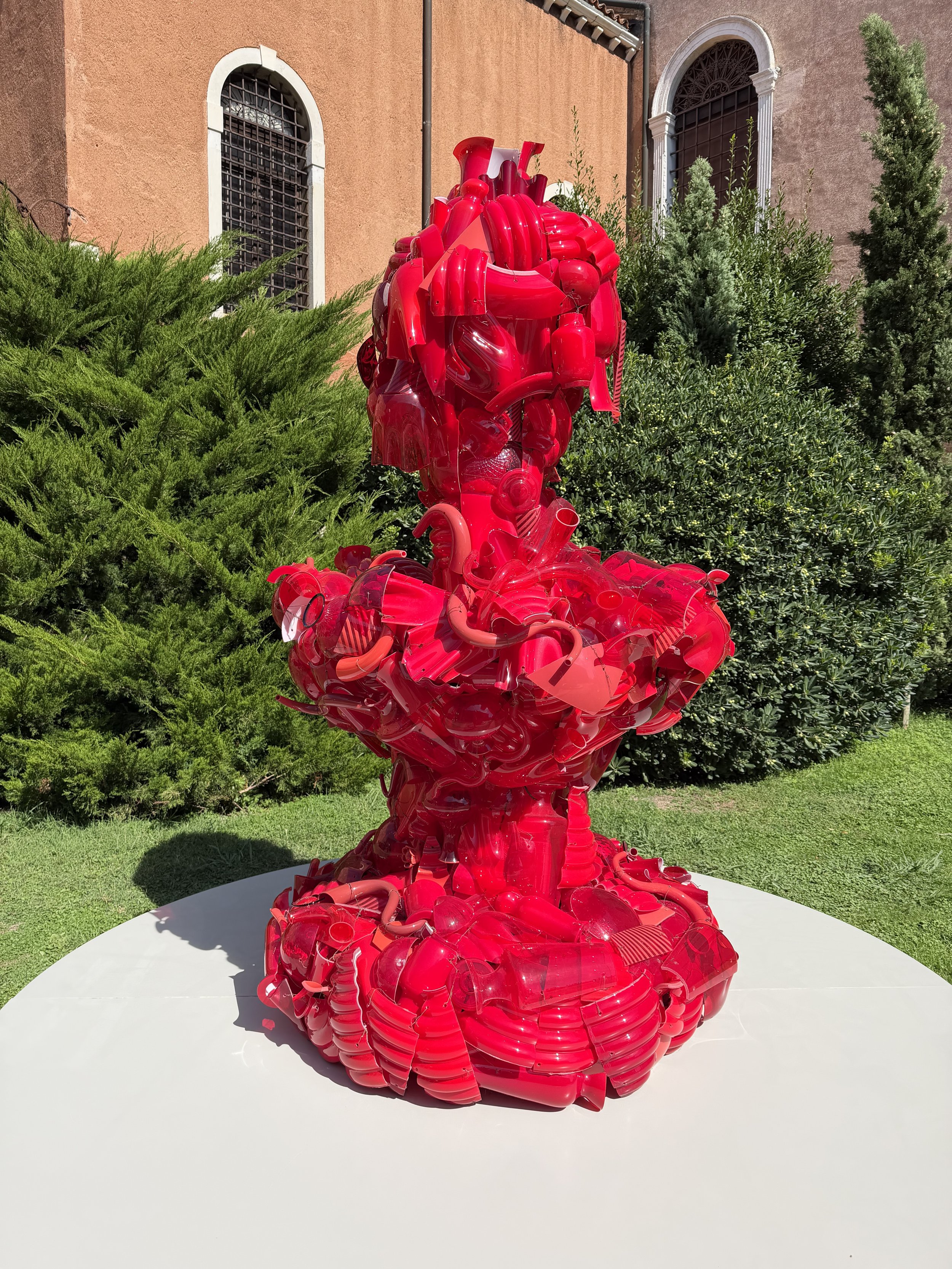
Venini & Fernando and Humberto Campana, Rivivo. Homo Faber 2026.
An Atelier Alive
Moving on, An Atelier Alive shifted the emphasis to making and to the hands behind objects. Two works here held my attention for very different reasons: one for its glowing, nested curves, the other for the images suspended within its surface.
Dale Chihuly’s Garnet Flame Basket Set looks almost as if several gestures of colour have settled together in one place. Amber and deep red gather in overlapping blown forms, and the openings make it possible to see one curve through another. The work has a sense of abundance, but it also rewards a slower look at the thin rims and the way the inner pieces rest within the larger whole.
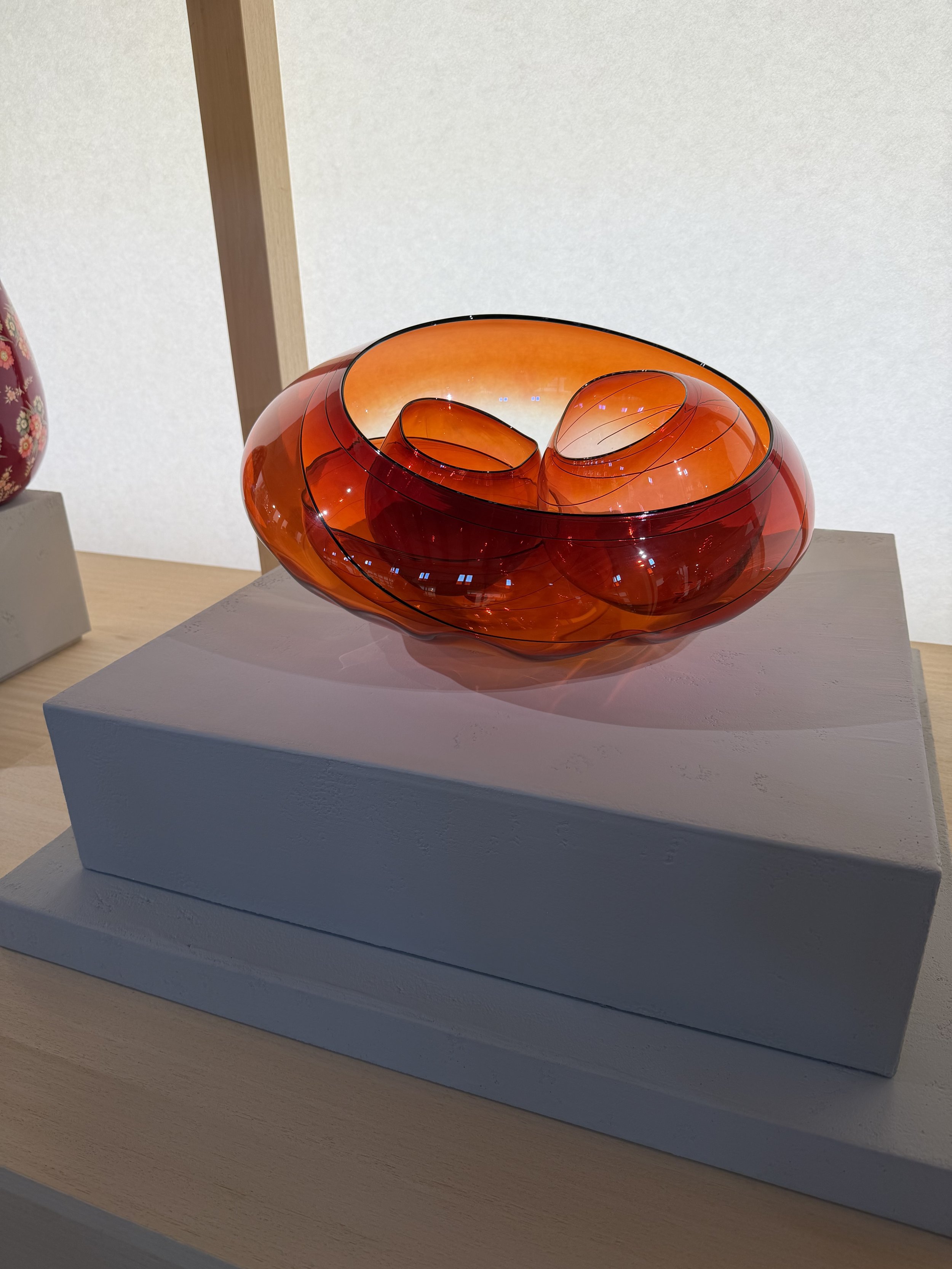
Dale Chihuly, Garnet Flame Basket Set. An Atelier Alive, Homo Faber 2026.
In Peter Hermansson’s Down the stairs, I first saw a face; then the face multiplied and changed. Eyes, profiles and dark graphic marks seem to travel around the curved vessel. The images are embedded in a surface that bends them as I move, making it hard to settle on a single reading. It has the unease of a remembered dream, yet every turn reveals how carefully that visual complexity has been constructed.
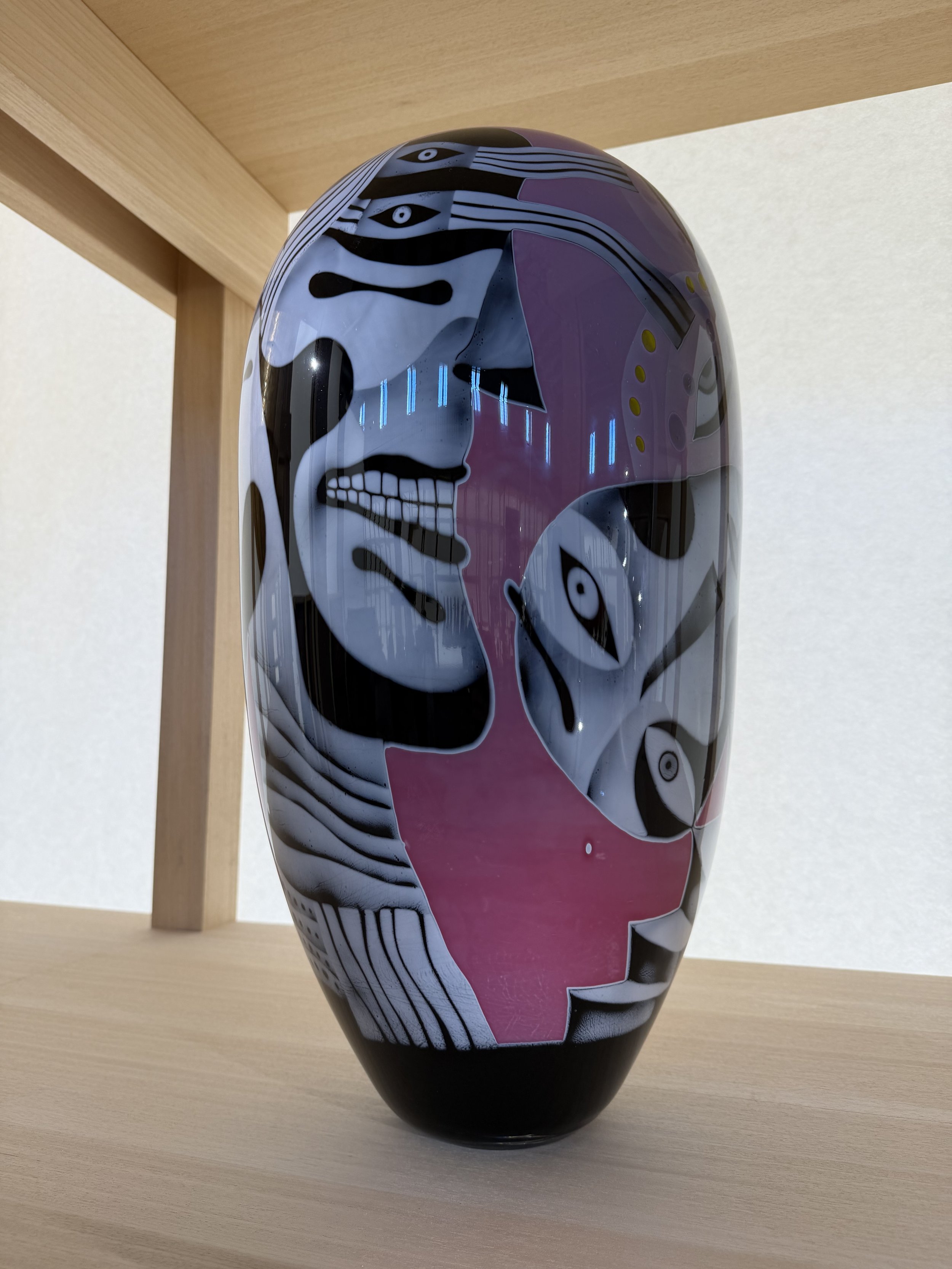
Peter Hermansson, Down the stairs. An Atelier Alive, Homo Faber 2026.
An Infinite Birdsong
An Infinite Birdsong was a sharp change of atmosphere. Illuminated frames and reflections multiplied through a narrow, glittering room, drawing visitors into the installation itself. After the individual works I had been studying, the space made looking feel almost physical.
In the mirrored passages, a glance could become a series of images receding into the distance. The intricate objects appeared and disappeared among those reflections. I found myself looking up, across, and back again, never quite sure where the room ended.
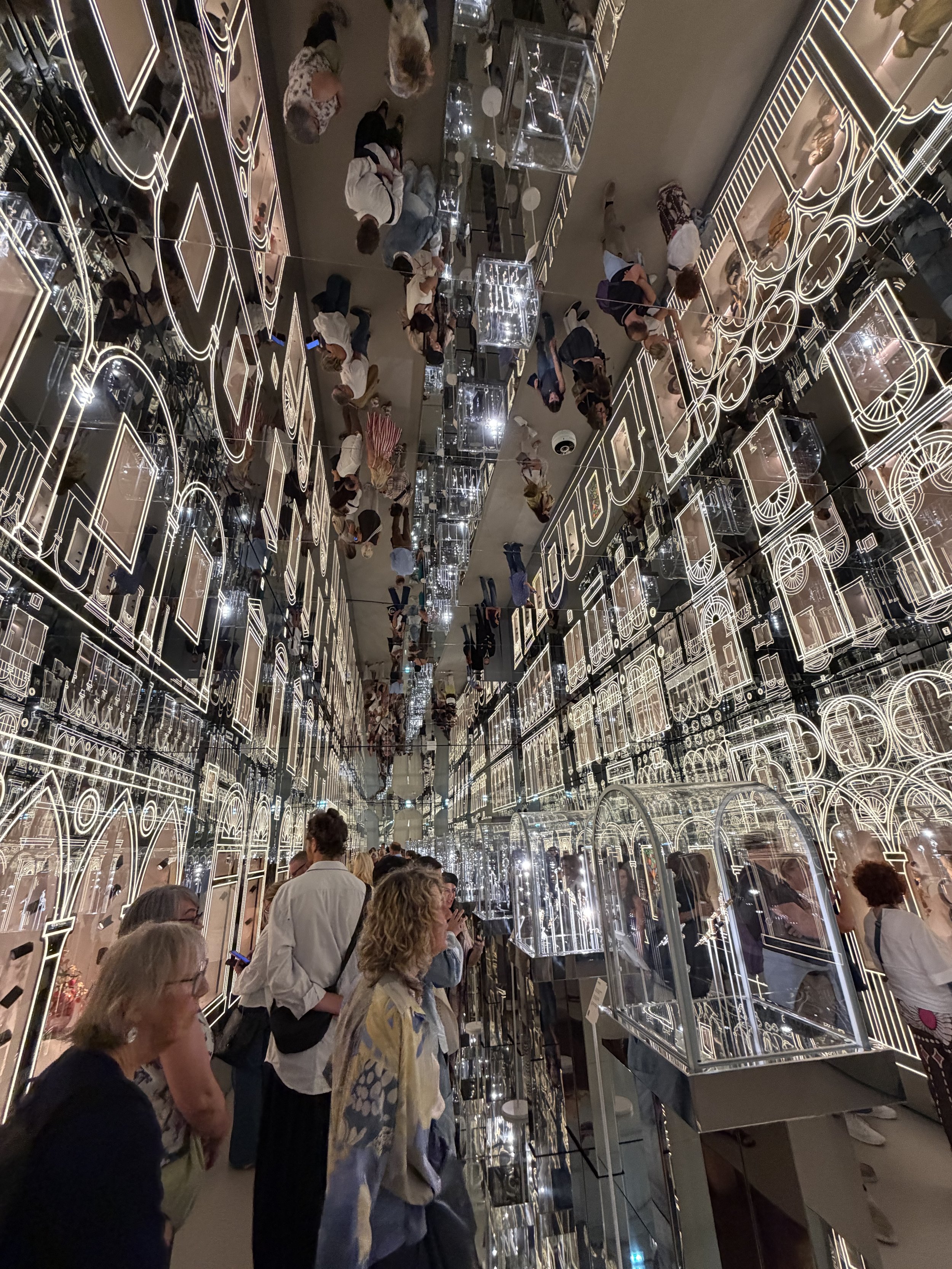
Installation view, An Infinite Birdsong, Homo Faber 2026.
This photograph catches something of that experience: being inside the display rather than standing neatly in front of it. The repeated lights and frames turn a simple reflection into part of the room’s pattern. It is also a reminder that an exhibition is remembered through the body moving through it, not only through images of isolated objects.
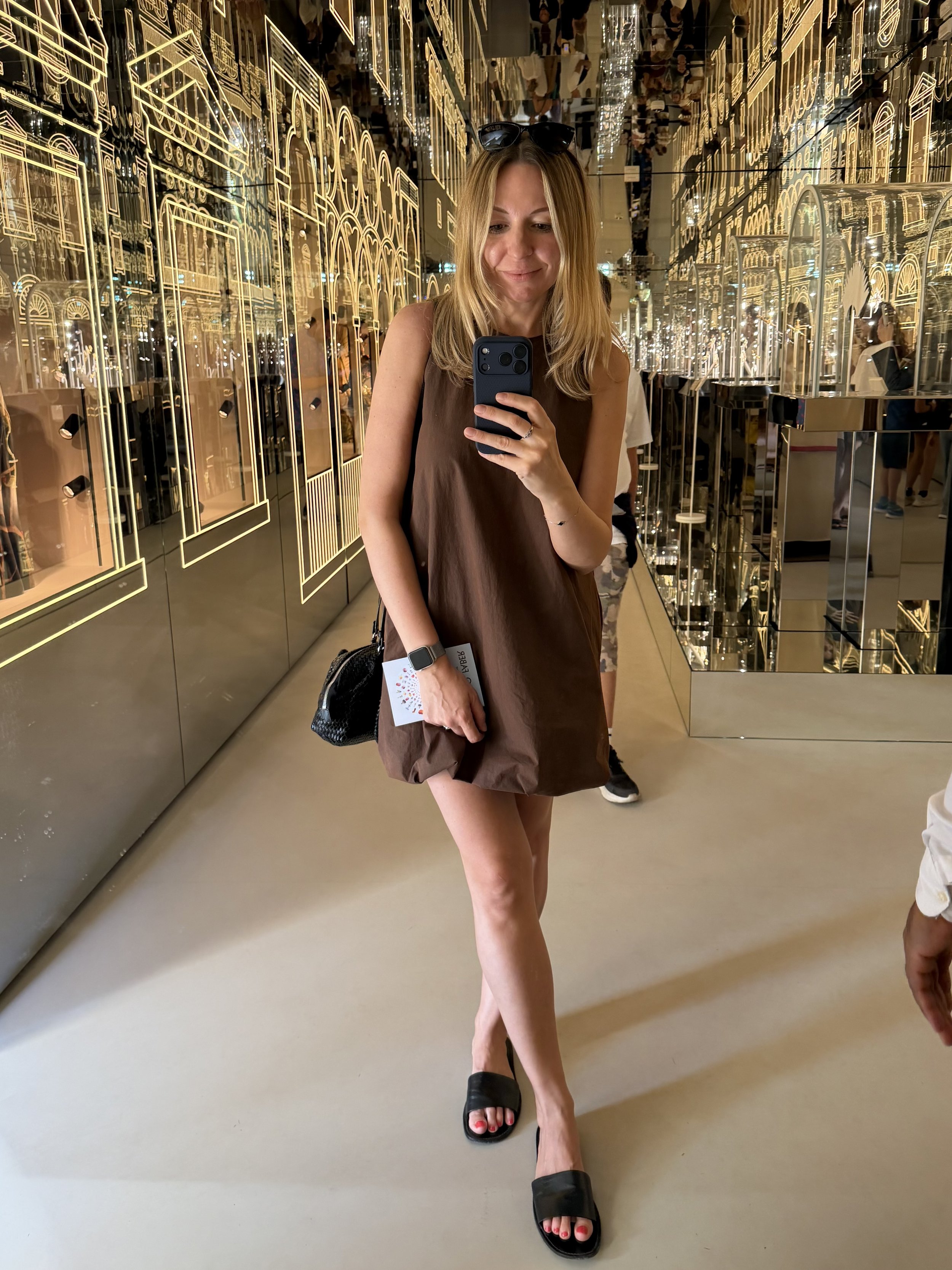
A moment inside An Infinite Birdsong, Homo Faber 2026.
Leaving the mirrored room, I came to the staircase leading to the Palladian Refectory and looked up. Enormous white birds filled the space above me, their wings caught in different moments of flight. Lit from within, they looked almost magical. The closer I looked, the more clearly I could see the delicate lines of their feathers—and the paper from which they were made.
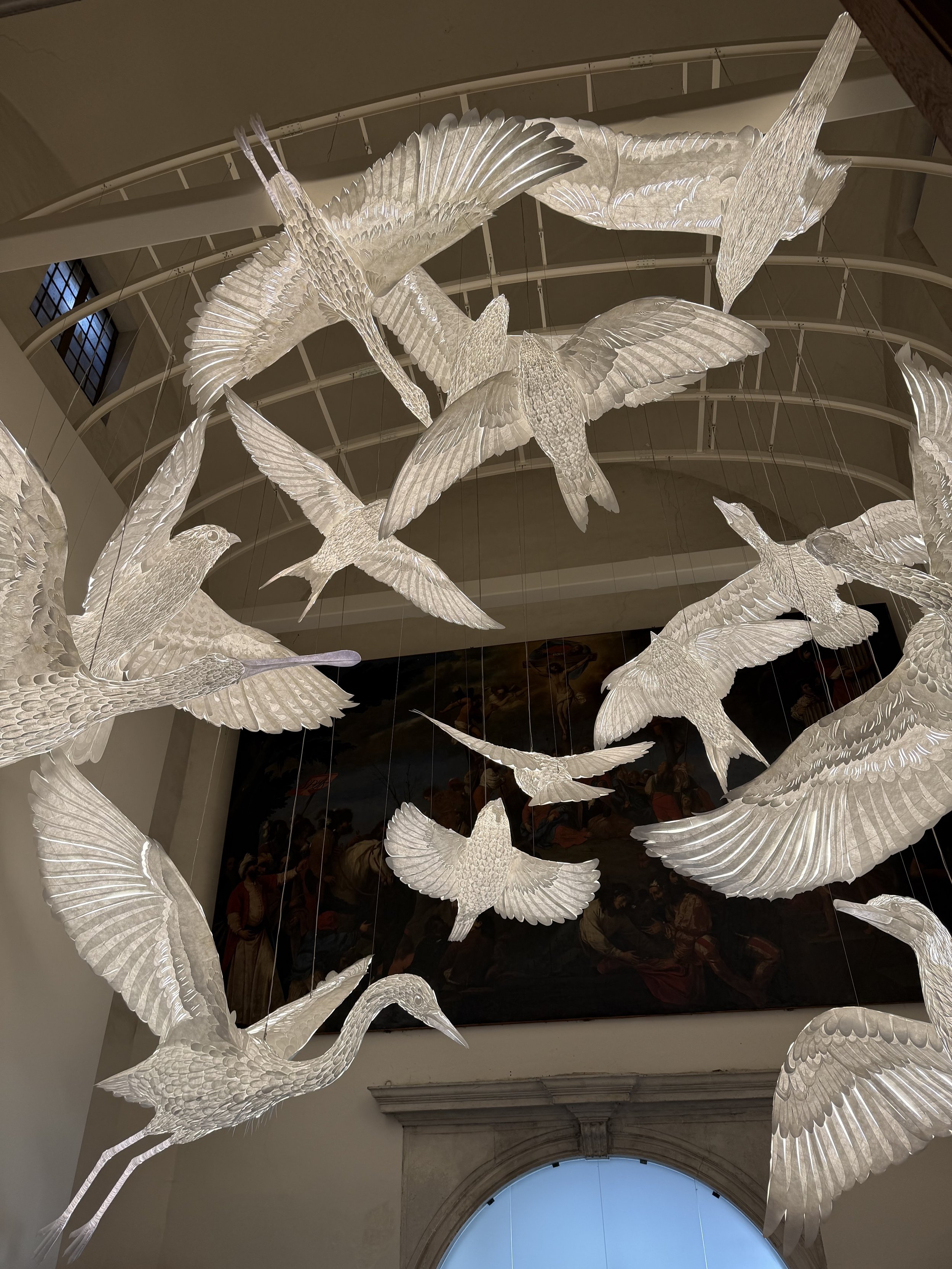
Wen Qiuwen, A Luminous Ark, based on drawings by Es Devlin and her team. Homo Faber 2026.
A Rainbow of Forms
Later, A Rainbow of Forms opened into a much brighter register. Mirrored shelves, a mirrored ceiling and a broad sweep of colour below brought dozens of materials together. Glass did not dominate the room; it caught and redirected the colour around it, sometimes with exuberance, sometimes with surprising restraint.
Seen from above, the colour of the floor becomes an almost continuous field, while the objects form an illuminated perimeter. From within the room, I kept moving between the whole composition and the specific works that resisted being absorbed into it.
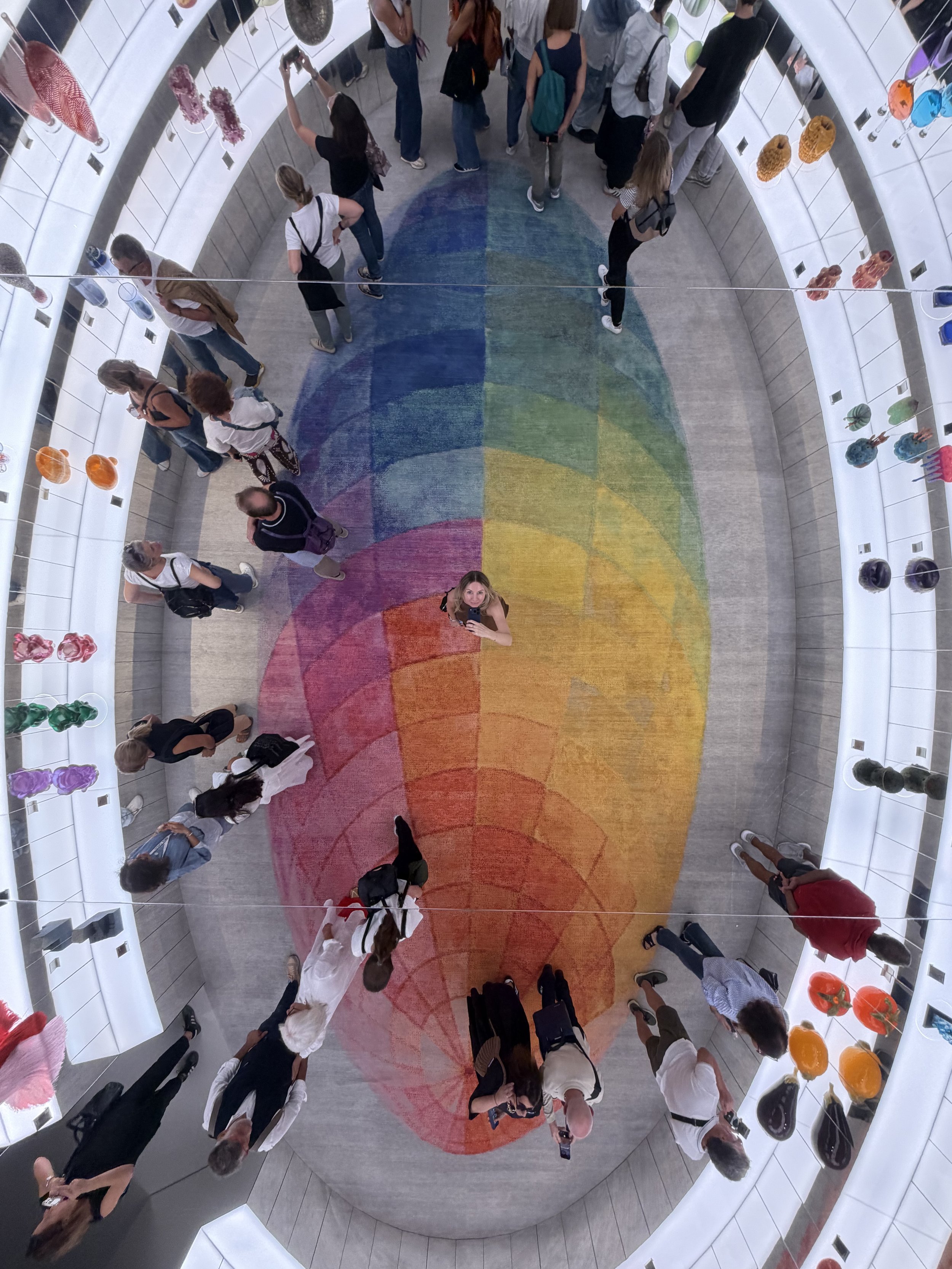
A Rainbow of Forms reflected in the ceiling mirror. Installation view, Homo Faber 2026.
Aya Oki’s Bloom LVII first reads as a burst of clear loops carrying small flashes of green, pink and gold. With more time, those loops become a record of expansion and return: each curve seems to have grown out of the next. Its transparent passages let the surrounding room enter the sculpture, while the coloured edges hold the eye close.
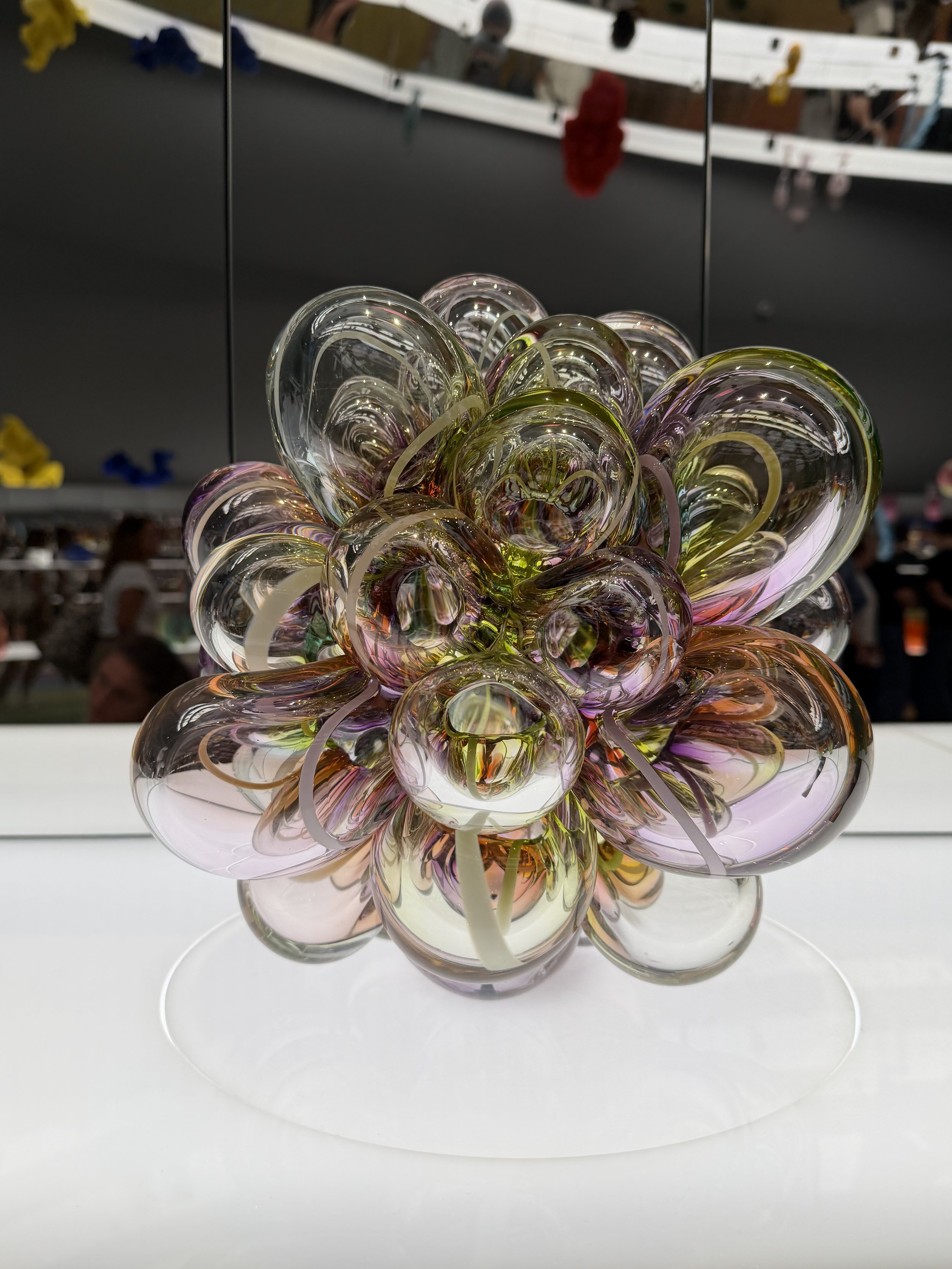
Aya Oki, Bloom LVII. A Rainbow of Forms, Homo Faber 2026.
The steeply tilted opening of Elodie Holmes’s Contorta caught my eye before anything else. It exposes a deep red interior, while the outer surface carries amber, violet and smoky bands that curve around the vessel. Beneath it, a bright amber loop sweeps outward, giving the whole composition an unexpected sense of lift. I kept tracing that loop back towards the body, trying to understand how the curves belonged together. The work’s movement comes from this particular arrangement: the slanting rim, the rounded weight above, and the looping line that carries it.
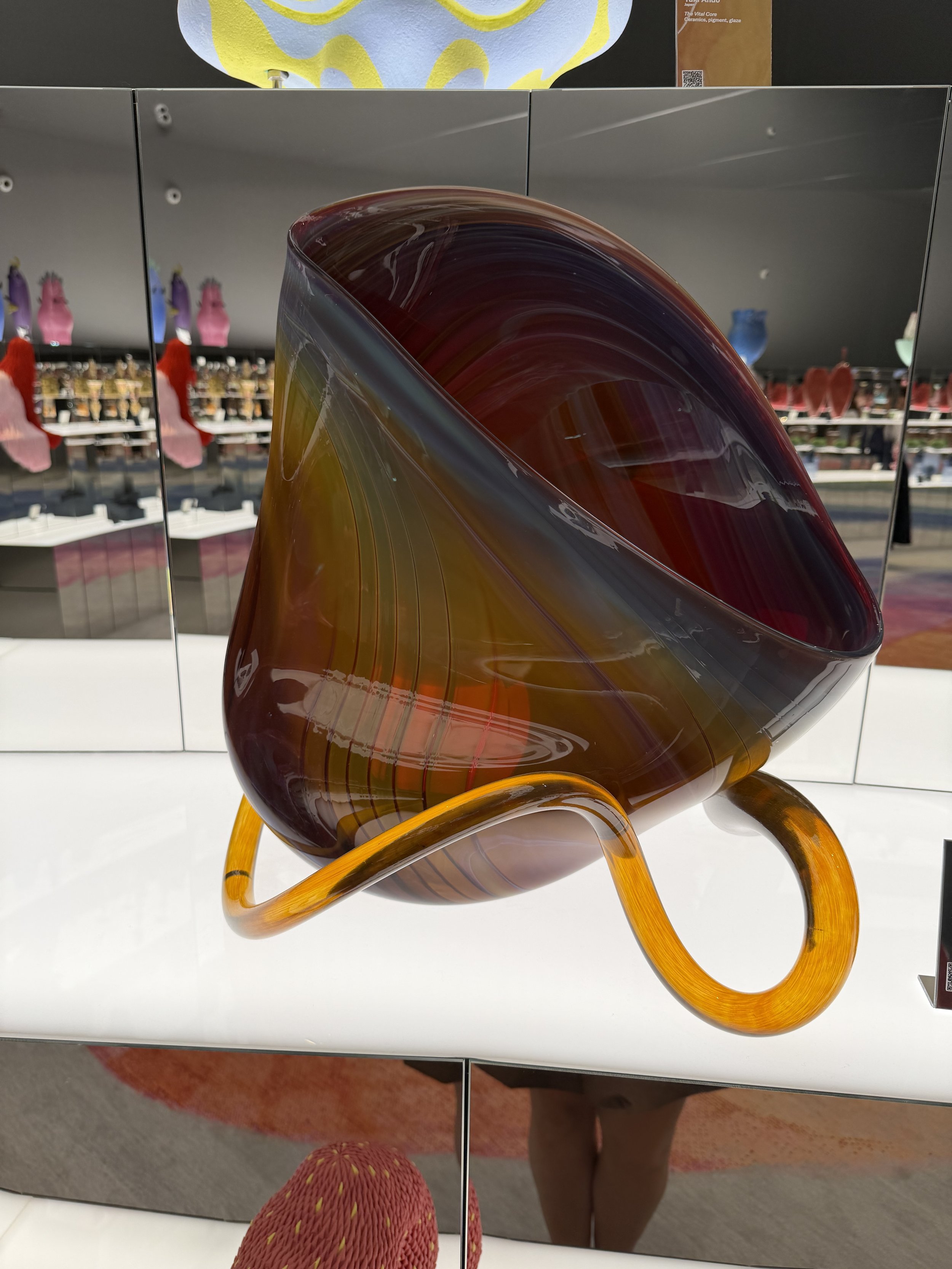
Elodie Holmes, Contorta. A Rainbow of Forms, Homo Faber 2026.
Hana Hillerová’s Riot of Spring first drew me in with its apparent softness. The three vessels, in pink, green and reddish tones, share broad, curling folds, but colour changes how I see their depth and volume. Their matte surfaces diffuse the light, giving the glass an unexpectedly tactile presence. Looking closer, I began to follow the openings and the places where one fold presses against another, finding a different rhythm in each form.
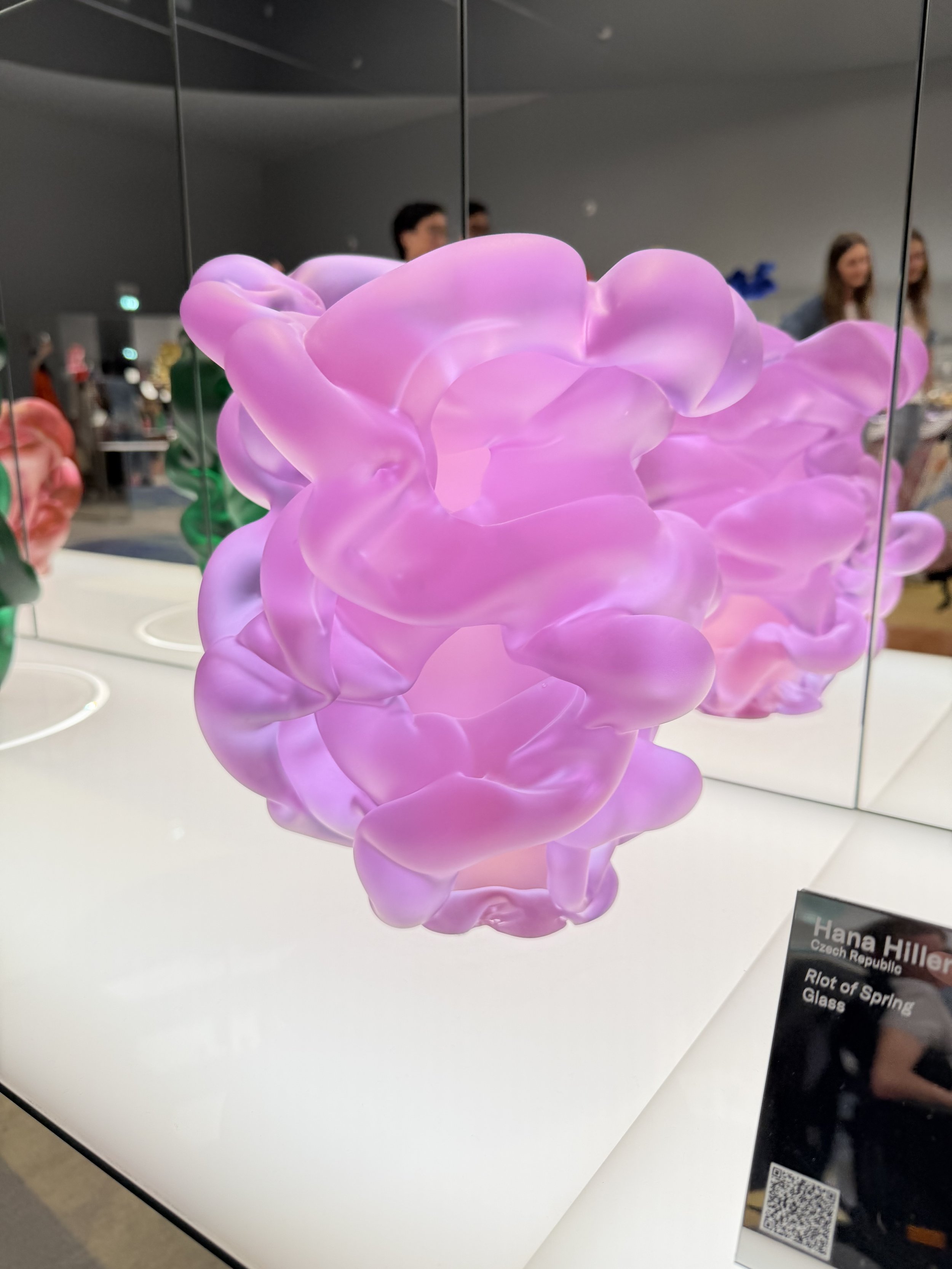
Hana Hillerová, Riot of Spring. A Rainbow of Forms, Homo Faber 2026.
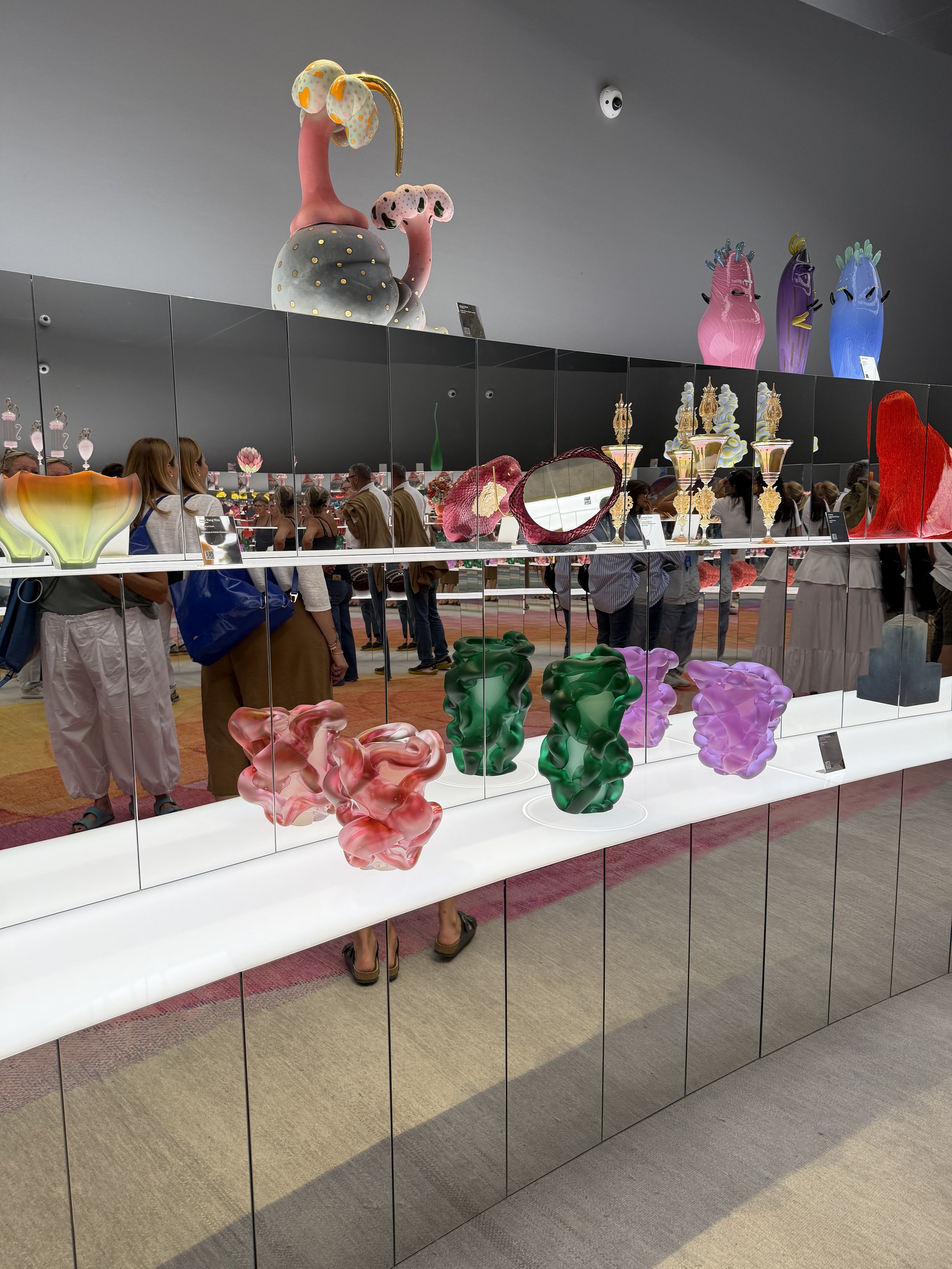
Hana Hillerová, Riot of Spring. Three vessels in pink, green and reddish tones. Installation view, A Rainbow of Forms, Homo Faber 2026.
George William Bell’s Fluid Topographies: Object 7 made me pause because its golden surface looked almost like softly pleated fabric. Fine vertical lines run down the rounded body, interrupted by short horizontal ridges with smooth, swollen edges. Those interruptions are what held my attention: they seem to push through the vertical grain, bending it around them. Looking closer, I noticed how the light gathers along each ridge and fades into the recesses beneath it. The surface has a softness that makes the solid glass unexpectedly difficult to read at first.
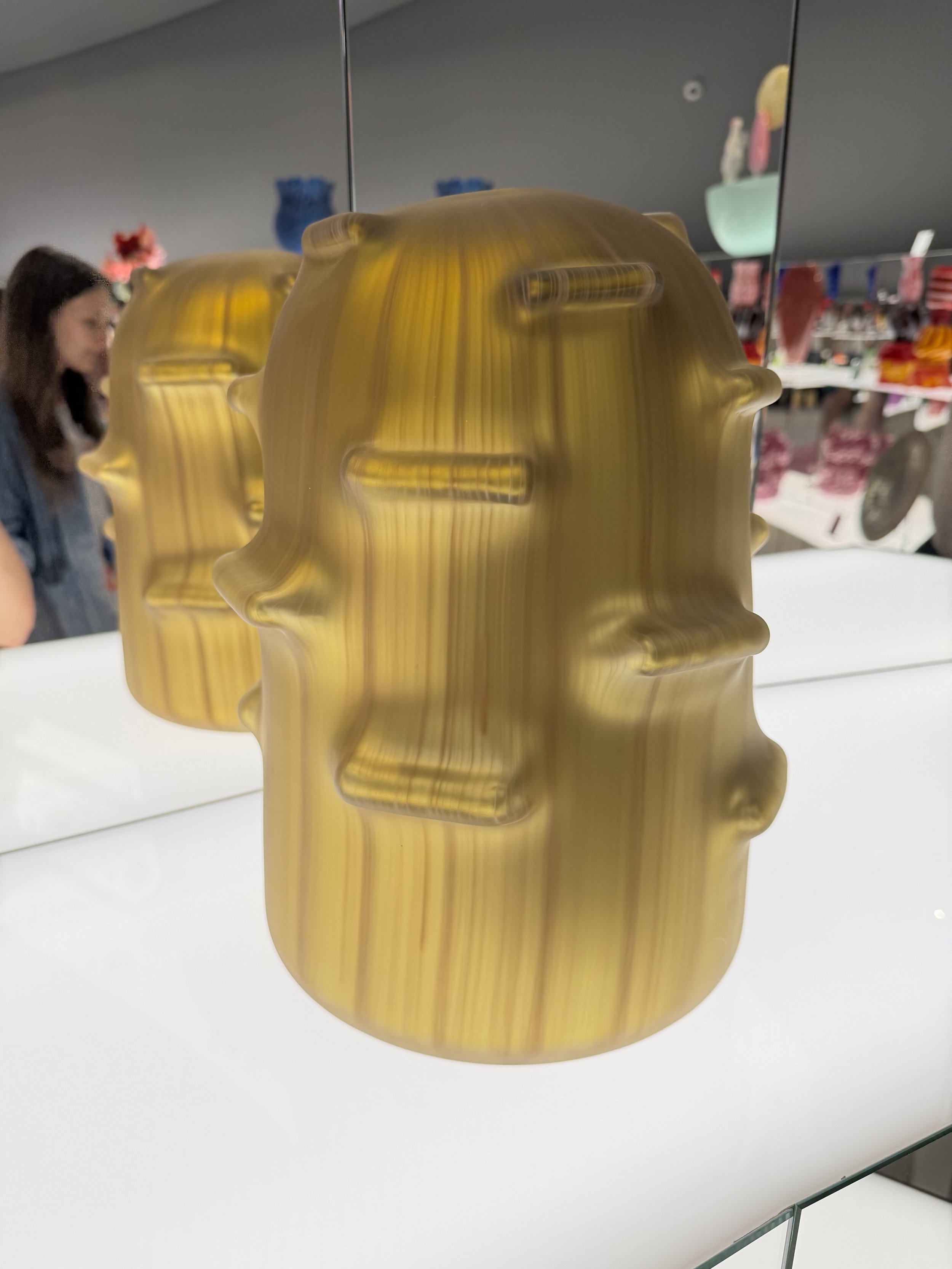
George William Bell, Fluid Topographies: Object 7. A Rainbow of Forms, Homo Faber 2026.
What struck me most about Jiyong Lee’s Green Ovoid Diatom and Green Tetrahedron Diatom was how much seemed to happen inside their quiet outlines. In the rounded form, a darker green volume appears enclosed within a pale, translucent shell. In the triangular piece, distinct planes divide the interior into bands of colour and light. Those precise boundaries held my attention: they make the glass feel layered and intricate even where its outer surface is perfectly smooth. Moving around the works, I kept discovering new relationships between the visible divisions and the depths beyond them..
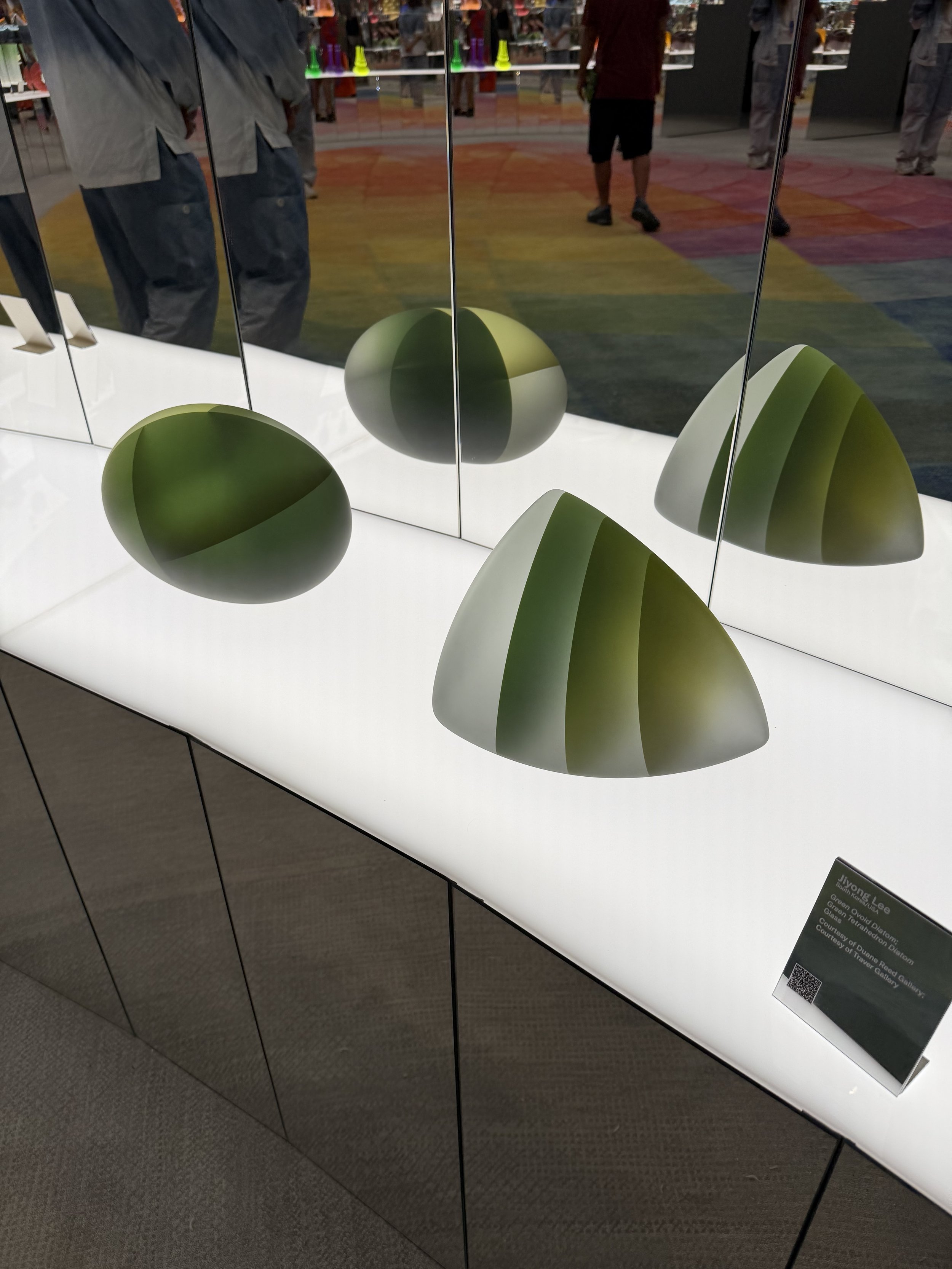
Jiyong Lee, Green Ovoid Diatom and Green Tetrahedron Diatom. A Rainbow of Forms, Homo Faber 2026.
In David Patchen’s Cerulean Glow Foglio, I was drawn to the blue centres scattered across the vessel, each surrounded by fine green lines and a pale outline. From a distance, they form a coherent pattern; closer in, their different sizes and shapes become absorbing. The pattern stretches into narrow elements near the base and follows the upward sweep of the two tips. What impressed me was how closely the detail belongs to the form. My eye could move from a single intricate element to the entire silhouette without losing the connection between them.
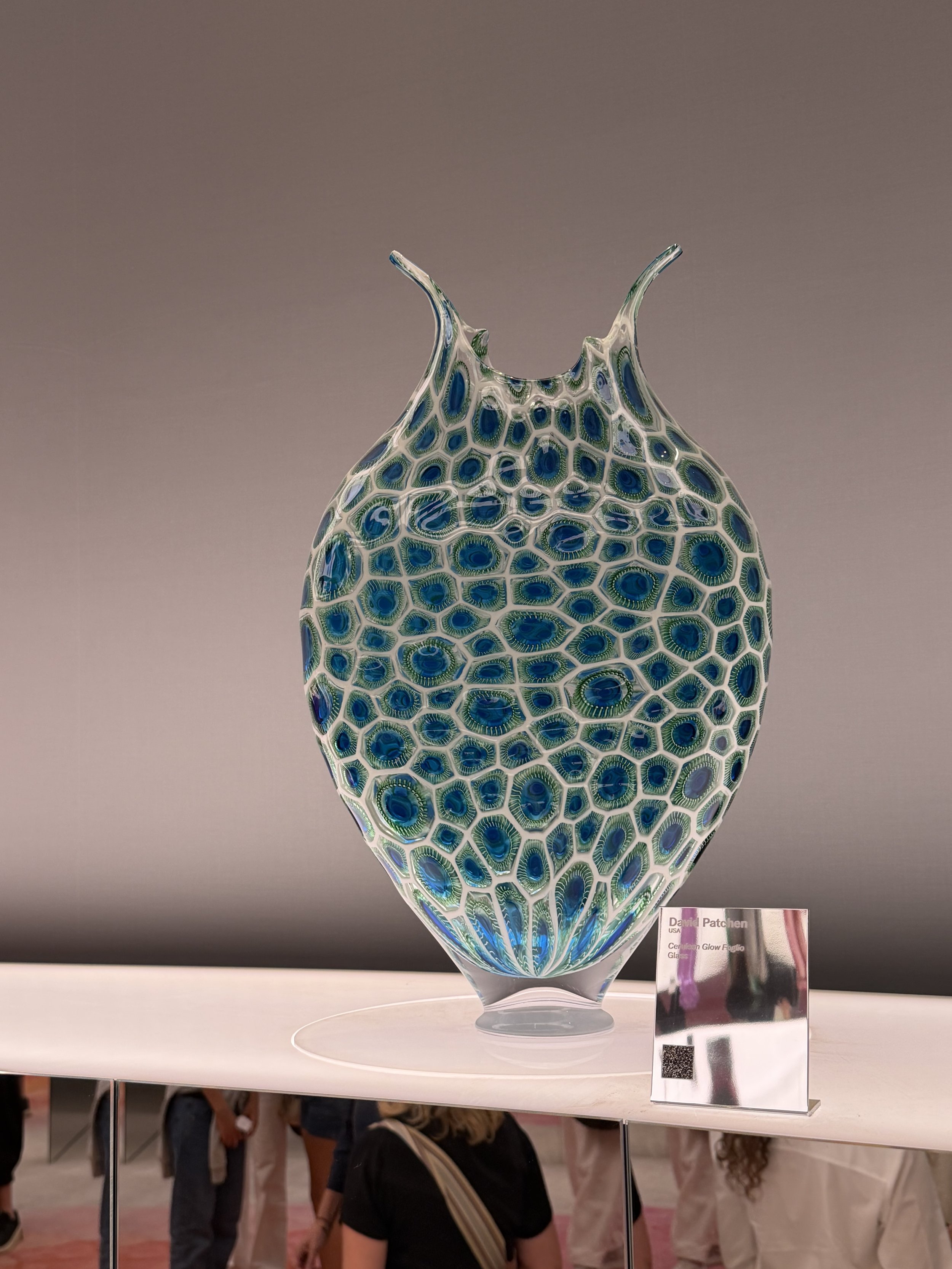
David Patchen, Cerulean Glow Foglio. A Rainbow of Forms, Homo Faber 2026.
Colin Reid’s Caleta struck me through the contrast between its slender, upright silhouette and its densely uneven surface. Pale ridges cross the blue glass, enclosing angular passages that vary from luminous turquoise to almost black. I wanted to look into those darker areas: they give the sculpture a depth that its narrow outline does not prepare you for. Closer inspection reveals small ledges, folds and abrupt changes of direction across the face. The work makes a rocky texture newly absorbing by allowing light into places that would ordinarily remain opaque.
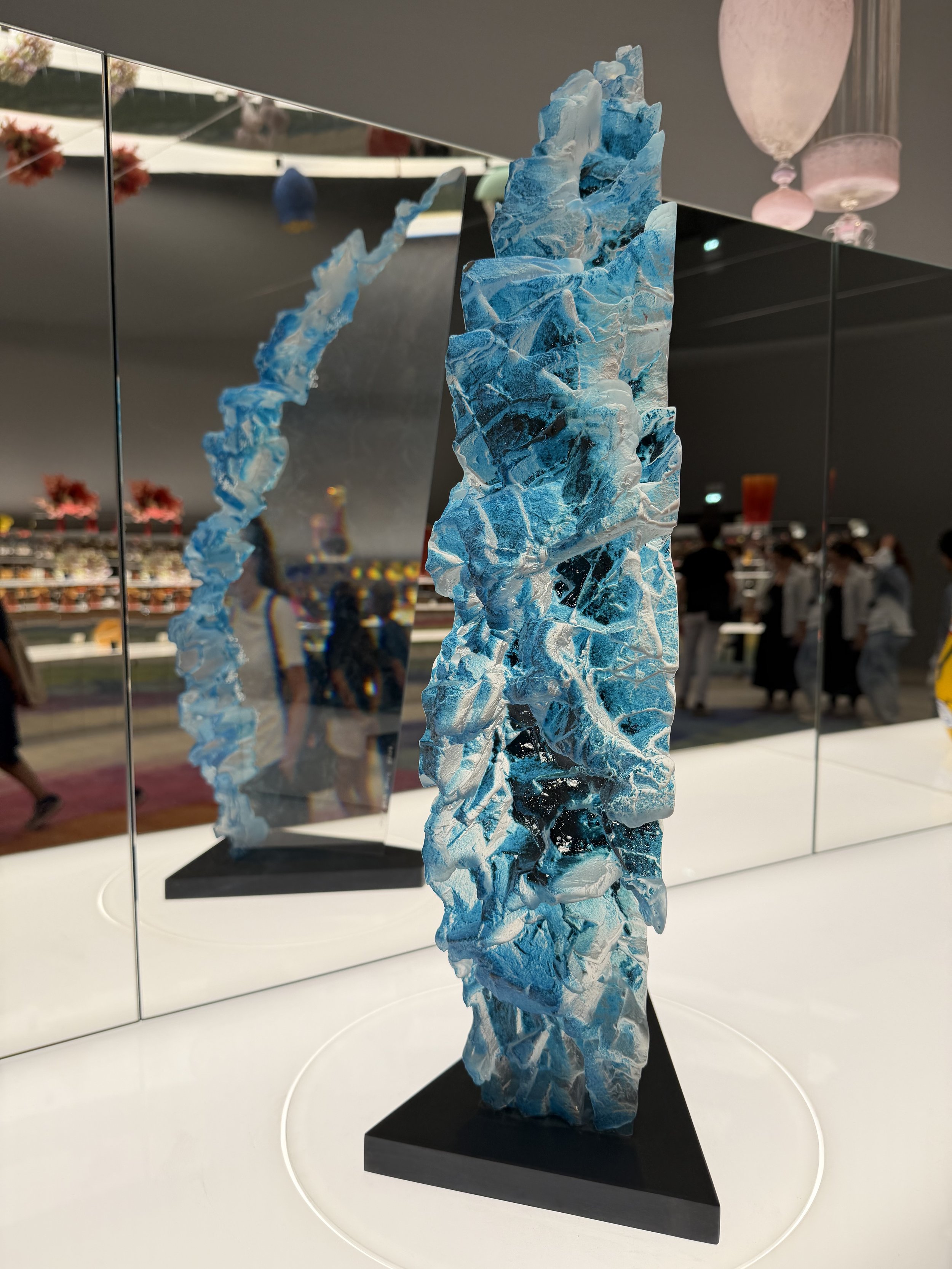
Colin Reid, Caleta. A Rainbow of Forms, Homo Faber 2026.
Leaving the exhibition, I was struck by how little these works had in common beyond their material. Glass had been folded, blown, cast, layered, etched and shaped into forms that suggested cloth, water, bodies, plants and stone. What stayed with me was the change that happened between the first glance and the second: the moment an object I thought I understood opened into something else.
All photographs by the author.